


It is a long established fact that a reader will be distracted by the readable content of a page when looking at its layout. The point of using Lorem Ipsum The man, who is in a stable condition in hospital, has “potentially life-changing injuries” after the overnight attack in Garvagh, County Lono donderry. He was shot in the arms and legs.”What sort of men would think it is accepttable to sub ject a young girl to this level of brutality and violence?
Every organization that works with communities, whether a non-profit, government agency, higher education institution, or social enterprise, has run a consultation at some point. A survey, a focus group, a town hall that generated goodwill on paper. But good intentions do not automatically produce good engagement. The communities that organizations exist to serve are frequently the last to have their expertise embedded in the design of that work, and that gap between stated commitment and structural reality is where programs fail, trust erodes, and resources are wasted. Meaningful community engagement is a practice that requires intentional design, structural accountability, and a willingness to share power. When done well, it produces better research, stronger programs, and more sustainable outcomes. On the other hand, when it is done poorly, it causes real harm.
This post breaks down what separates tokenistic consultation from genuine co-design, why extractive research is a risk organizations can no longer afford to ignore, and what a people-centred, evidence-grounded engagement practice actually looks like in action
What Is Actually Happening Out There
Organizations are under enormous pressure to demonstrate community input. Funders require it. Accreditors ask for it. Strategic plans promise it. But the structures that enable genuine community participation, time, compensation, accessible formats, decision-making authority, are often the first things cut when budgets tighten or timelines compress. The result is a consultation industry that is wide in reach and shallow in depth. Communities are engaged after decisions have already been made, invited into processes designed around organizational convenience rather than community capacity, and then observed from a distance as their input is filtered through institutional priorities before it ever touches program design.
This pattern has a name. Extractive knowledge, using community members’ experiences, expertise, and stories for the ends of the institution rather than the community itself, has been identified as a form of epistemic injustice particularly prevalent in community-engaged research and program development (McHugh et al., 2024). For Black, Indigenous, and racialized communities, this is not a new dynamic. The history of research conducted on communities without their consent, shaped by colonial frameworks that treated people as data sources rather than knowledge holders, continues to shape how communities respond to institutional invitations to “participate” (Smith, 2012; Walcott & Abdillahi, 2019). Although not always intentional, the impact is the same: communities bear the cost of participation without sharing in the benefit of the work.
The Problem: Consultation Without Power Is Not Engagement
The critical distinction most organizations miss is this: consultation is about gathering information. Engagement is about sharing power.
This is not a new insight. Arnstein’s (1969) foundational Ladder of Citizen Participation established more than five decades ago that genuine participation requires the redistribution of power, and that informing, consultation, and placation, while often presented as participation, are in practice forms of tokenism that allow communities to be heard without granting them any real influence over decisions. Arnstein’s analysis remains as relevant today as when it was written: processes that refuse to move beyond the lower rungs of the ladder are still the norm rather than the exception in most organizational contexts.
Consultation asks communities what they think. Co-design asks communities to help determine what gets built, how it gets built, and who defines success. These are not the same thing, and conflating them is one of the most common and costly mistakes organizations make.
When communities are brought in only to validate decisions already made, several things happen. Trust erodes. Attendance drops. The same organizations find themselves wondering why they cannot reach the communities they claim to serve. The answer is usually that those communities have been through this before, they have offered their time, their stories, and their expertise to processes that produced little change in their lives and considerable benefit to the institutions that ran them. For Black and Indigenous communities in particular, this dynamic carries the weight of a much longer history of research exploitation, one that mandates earned trust through structural accountability (Breland-Noble et al., 2024; Smith, 2012).
What Evidence and Practice Show
The evidence for co-production approaches is consistent. Community-based participatory research (CBPR), one of the most rigorously studied frameworks for equitable community engagement, positions community members not as subjects of research but as equal partners in every stage of the process (Minkler & Wallerstein, 2008). CBPR recognizes community as a unit of identity, emphasizes co-learning and local capacity building, and maintains a long-term commitment to engagement that outlasts any single project or grant cycle.
Research conducted with Black communities specifically finds that CBPR is particularly critical for addressing social and health inequities that have historically been ignored or misrepresented in research produced without meaningful Black participation (Breland-Noble et al., 2024). Community-based participatory approaches can improve outcomes through collaboration, empowerment, and cultural sensitivity, and the under-representation of Black researchers and community members in research design is itself a structural barrier to equity.
Smith (2012) argues powerfully that decolonizing research methodology requires more than adding community voices to existing frameworks, it requires fundamentally rethinking who holds the question, who designs the method, and who owns the findings. This is as relevant to non-profit program evaluation as it is to academic research. Indigenous research ethics protocols across Canada increasingly embed principles of community ownership, control, access, and self-determination as non-negotiable conditions of ethical engagement (Hayward et al., 2021).
In the Canadian context, Fierheller et al. (2024) demonstrate that equitable community-based data systems require explicit governance frameworks, including the Black Health Equity Working Group’s EGAP (Engagement, Governance, Access, and Protection) principles and the First Nations Information Governance Centre’s OCAP (Ownership, Control, Access, and Possession) framework, as foundations for meaningful, non-extractive engagement. These frameworks operationalize equity through structural mechanisms that communities control.
Practically, this means:
- Communities need to be at the table when research questions are being written
- Participation needs to be compensated, accessible, and scheduled around community capacity
- Decision-making authority needs to be explicitly defined and genuinely shared
- Findings need to return to communities in usable, accessible forms before they are published in academic journals or presented to funders (Minkler & Wallerstein, 2008)
The Polus Consult Lens: Evidence, Equity, and People-Centred Practice
At Polus Consult, our approach to community engagement is built on a conviction we carry from four decades of combined practice: the communities closest to a problem hold knowledge that no research design, theory of change, or strategic plan can replace. That means expertise without community knowledge produces programs that miss the mark, polished, well-funded, and fundamentally disconnected from the lives they are meant to serve.
Our engagement work is grounded in three principles:
Evidence over assumption. We do not design engagement processes based on what has always been done. We draw on participatory research methodology, decolonial frameworks, and current evidence on what produces genuine co-production rather than token consultation.
Equity and inclusion by design. Who is in the room matters — and so does who is not. We pay explicit attention to which voices are systematically excluded from consultation processes and why, centering the perspectives of Black, Indigenous, racialized, and other equity-deserving communities in how we design and evaluate engagement.
People-centred practice. Every engagement process we design starts with the question: what does meaningful participation look like for this specific community, in this specific context? For instance, certain communities face documented barriers to research participation rooted in cultural, linguistic, and historical mistrust of institutions, barriers that culturally congruent, community-based strategies can address when organizations invest the time to understand them (Leh & Saoud, 2020).
Practical Steps: Moving From Consultation to Co-Design
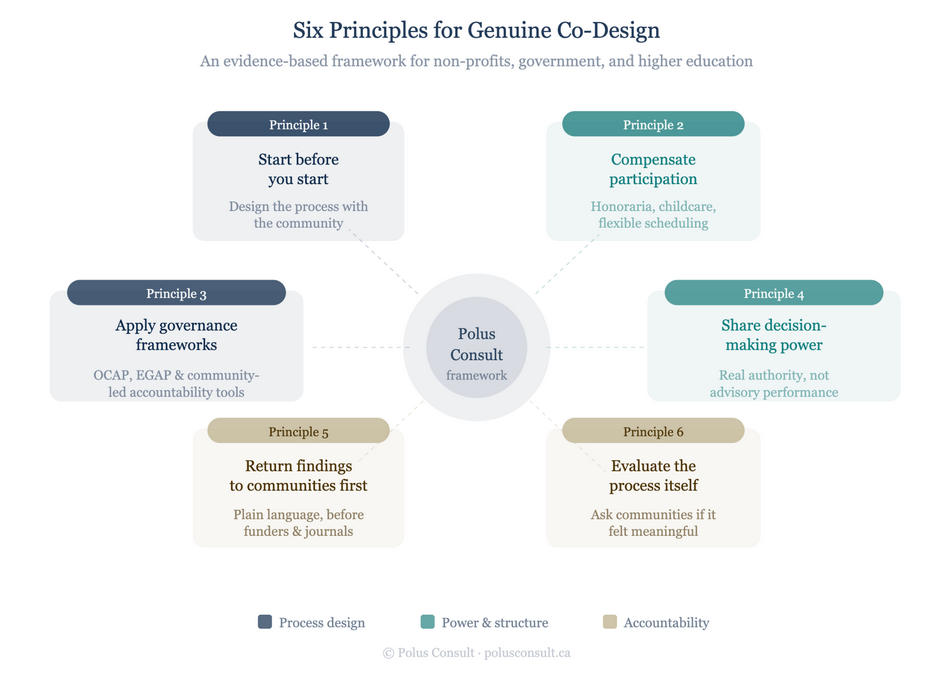
Whether you are designing a new program, conducting a community needs assessment, or developing a strategic plan, the following steps will help shift your engagement practice from extractive to genuinely participatory:
- Start before you start. Bring community members into the design of the engagement process itself, before questions are written, methods are chosen, or timelines are set. Ask: who needs to be at this table, and what do we need to do to make that possible?
- Compensate participation. Community members’ time, knowledge, and expertise have value. Compensate them, through honoraria, gift cards, childcare support, or flexible scheduling. Uncompensated labour is a structural barrier to genuine co-design and a signal that the organization does not value what it claims to need.
- Separate data gathering from decision-making. Be explicit about what role community input will play. If you want genuine co-design, create actual decision-making structures —advisory bodies with real authority, community review of findings before publication, shared ownership of recommendations.
- Apply existing governance frameworks. Draw on established community-led frameworks such as OCAP principles for Indigenous data sovereignty and EGAP for Black community engagement. These are structural accountability tools developed by communities to protect themselves from extractive practice (Fierheller et al., 2024).
- Translate findings back to communities first. Before a report goes to a funder or a board, it should return to the community in accessible, plain-language form. Findings belong to the people who generated them (Minkler & Wallerstein, 2008).
- Evaluate the process, not just the output. Ask community members whether the engagement process itself felt meaningful, respectful, and worth their time. Their assessment of the process is as important as any finding it produces (Wallerstein & Duran, 2006).
An Example in Practice
Consider a non-profit preparing a needs assessment for a new mental health program serving Black youth in an urban Canadian context. The default approach is familiar: a consultant designs a survey, distributes it through the organization’s existing channels, analyzes responses, and produces a report with recommendations. The community is consulted. The report is filed. The program launches with low uptake, because the people it was designed for were not the ones who designed it.
A more honest and ethical approach requires designing the engagement process itself with more care, and being transparent about what the organization can and cannot do with what it hears.
In practice, this might look like: partnering with a community organization that already holds trust with Black youth and their families, rather than attempting direct outreach from a position of institutional distance. It means sitting in on existing community spaces (drop-ins, peer support groups, informal gatherings). It means asking a community liaison or peer worker, already employed by the partner organization, to shape the questions being asked. It means sharing a plain-language draft of the findings back to that partner before the final report is written, and adjusting what gets prioritized based on their response.
This practice requires time, humility, and a willingness to follow community lead rather than institutional convenience. It also requires honesty with the client about what the engagement process can reasonably deliver.
Findings that are shared back, questions that are shaped by community insiders, and processes that are built around existing community infrastructure rather than institutional need, these are achievable in almost any consulting engagement, at any budget level (Breland-Noble et al., 2024; Fierheller et al., 2024).
Conclusion: Engagement Is a Strategy
The organizations doing the most impactful work are the ones that have built genuine relationships that hold up when funding shifts, priorities change, and crises emerge. Co-design is the hardest, most rigorous, and most consequential work an organization can do. It requires humility, patience, structural change, and a willingness to be challenged by the communities you serve. And it produces the most durable results, programs that work because the people they serve helped design them.
Moving from consultation to co-design is the standard that equitable, decolonial, evidence-based engagement demands (Arnstein, 1969; McHugh et al., 2024; Smith, 2012). Organizations that reach it will become the partners that communities actually choose to work with
.Work With Polus Consult
If your organization is navigating community engagement, participatory research, or the shift from consultation to co-design, Polus Consult supports research, strategy, and engagement grounded in evidence and equity. We work with non-profits, higher education institutions, government agencies, and international organizations to design engagement processes that are meaningful, rigorous, and accountable to the communities they serve
.References
Arnstein, S. R. (1969). A ladder of citizen participation. Journal of the American Institute of Planners, 35(4), 216–224. https://doi.org/10.1080/01944366908977225
Breland-Noble, A., Streets, F. J., & Jordan, A. (2024). Community-based participatory research with Black people and Black scientists: The power and the promise. The Lancet Psychiatry, 11(1), 75–80. https://doi.org/10.1016/S2215-0366(23)00338-3
Fierheller, D., Chu, C., D’Silva, C., Krishendeholl, A., Arham, A., Carter, A., Dias, K., Francis, I., Glasgow, M., Malhotra, G., Zenlea, I., & Rosella, L. C. (2024). Using community-based participatory research methods to build the foundation for an equitable integrated health data system within a Canadian urban context. International Journal for Equity in Health, 23, Article 130. https://doi.org/10.1186/s12939-024-02179-3
Hayward, A., Sjoblom, E., Sinclair, S., & Cidro, J. (2021). A new era of Indigenous research: Community-based Indigenous research ethics protocols in Canada. Journal of Empirical Research on Human Research Ethics, 16(4), 403–417. https://doi.org/10.1177/15562646211023705
Leh, S. K., & Saoud, S. (2020). Using community-based participatory research to explore health care perceptions of a select group of Arab Americans. Journal of Transcultural Nursing, 31(2), 139–147. https://doi.org/10.1177/1043659619875181
McHugh, N. A., Kennedy, S., & Wright, A. (2024). Extractive knowledge: Epistemic and practical challenges for higher education community engagement. Metropolitan Universities, 35(1), 82–102. https://doi.org/10.18060/27552
Minkler, M., & Wallerstein, N. (Eds.). (2008). Community-based participatory research for health: From process to outcomes (2nd ed.). Jossey-Bass.
Smith, L. T. (2012). Decolonizing methodologies: Research and indigenous peoples (2nd ed.). Zed Books.
Walcott, R., & Abdillahi, I. (2019). BlackLife: Post-BLM and the struggle for freedom. ARP Books.
Wallerstein, N., & Duran, B. (2006). Using community-based participatory research to address health disparities. Health Promotion Practice, 7(3), 312–323. https://doi.org/10.1177/1524839906289376
Wallerstein, N., Duran, B., Oetzel, J., & Minkler, M. (Eds.). (2019). Community-based participatory research for health: Advancing social and health equity (3rd ed.). Jossey-Bass.